





Price: $39.95 - $34.41
(as of Aug 01, 2025 11:28:54 UTC – Details)
Follow the history of hot rodding through this nostalgic look at vintage speed equipment.
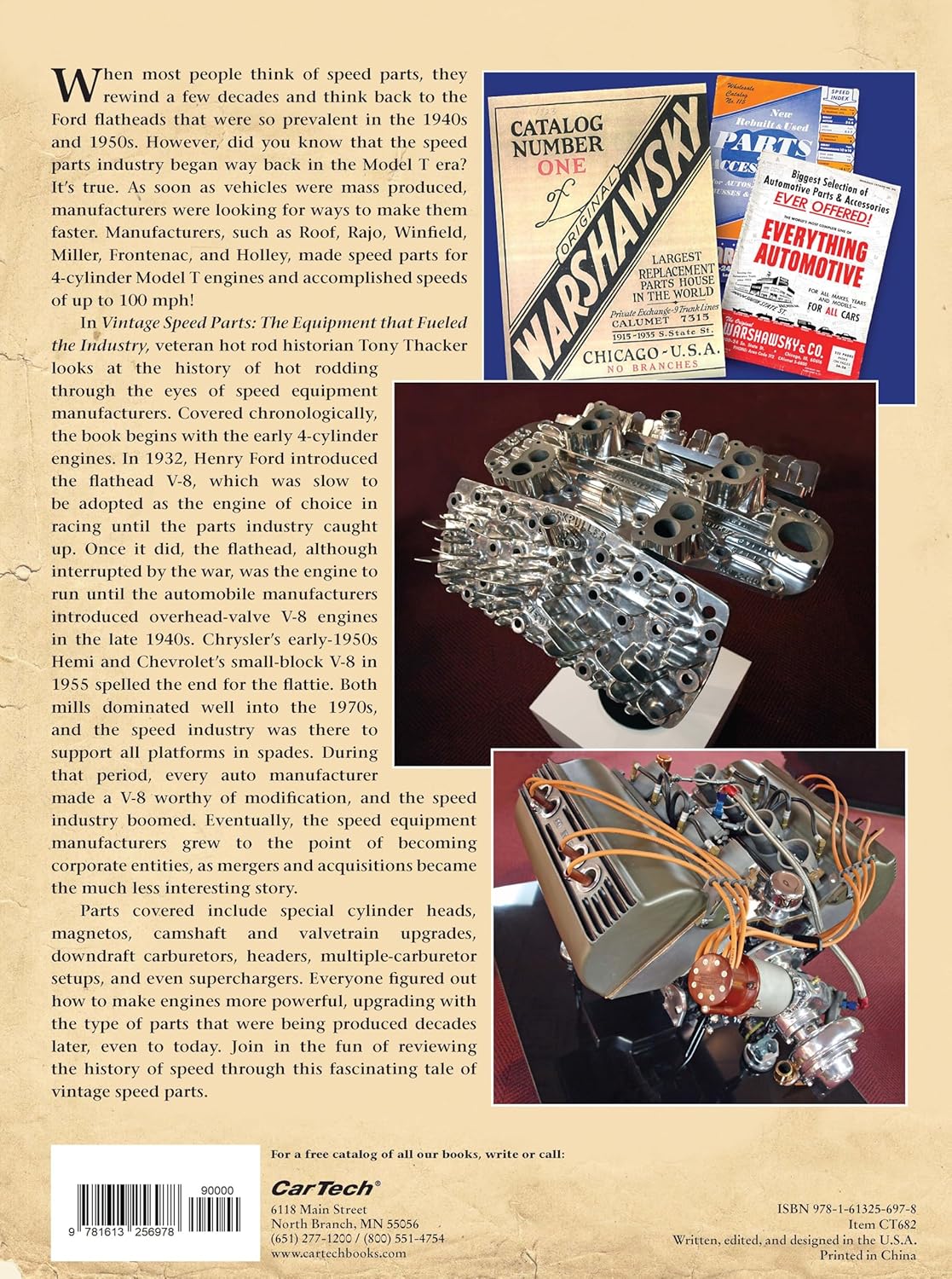
When most people think of speed parts, they rewind a few decades and think back to the Ford flatheads that were so prevalent in the 1940s and 1950s. However, did you know that the speed parts industry began way back in the Model T era? It’s true. As soon as vehicles were mass produced, manufacturers were looking for ways to make them faster. Manufacturers, such as Roof, Rajo, Winfield, Miller, Frontenac, and Holley, made speed parts for 4-cylinder Model T engines and accomplished speeds of up to 100 mph!
In Vintage Speed Parts: The Equipment That Fueled the Industry, veteran hot rod historian Tony Thacker looks at the history of hot rodding through the eyes of speed equipment manufacturers. Covered chronologically, the book begins with the early 4-cylinder engines. In 1932, Henry Ford introduced the flathead V-8, which was slow to be adopted as the engine of choice in racing until the parts industry caught up. Once it did, the flathead, although interrupted by the war, was the engine to run until the automobile manufacturers introduced overhead-valve V-8 engines in the late 1940s. Chrysler’s early-1950s Hemi and Chevrolet’s small-block V-8 in 1955 spelled the end for the flattie. Both mills dominated well into the 1970s, and the speed industry was there to support all platforms in spades. During that period, every auto manufacturer made a V-8 worthy of modification, and the speed industry boomed. Eventually, the speed equipment manufacturers grew to the point of becoming corporate entities, as mergers and acquisitions became the much less interesting story.
Parts covered include special cylinder heads, magnetos, camshaft and valvetrain upgrades, downdraft carburetors, headers, multiple-carburetor setups, and even superchargers. Everyone figured out how to make engines more powerful, upgrading with the type of parts that were being produced decades later, even to today. Join in the fun of reviewing the history of speed through this fascinating tale of vintage speed parts.
From the Publisher

Veteran hot rod historian Tony Thacker looks at the history of hot rodding through the eyes of speed equipment manufacturers. The book begins with the early 4-cylinder engines.
In 1932, Henry Ford introduced the flathead V-8, which was slow to be adopted as the engine of choice in racing until the parts industry caught up. Once it did, the flathead, although interrupted by the war, was the engine to run until the automobile manufacturers introduced overhead-valve V-8 engines in the late 1940s. Chrysler’s early-1950s Hemi and Chevrolet’s small-block V-8 in 1955 spelled the end for the flattie. Both mills dominated well into the 1970s, and the speed industry was there to support all platforms in spades. During that period, every auto manufacturer made a V-8 worthy of modification, and the speed industry boomed. Eventually, the speed equipment manufacturers grew to the point of becoming corporate entities, as mergers and acquisitions became the much less interesting story.

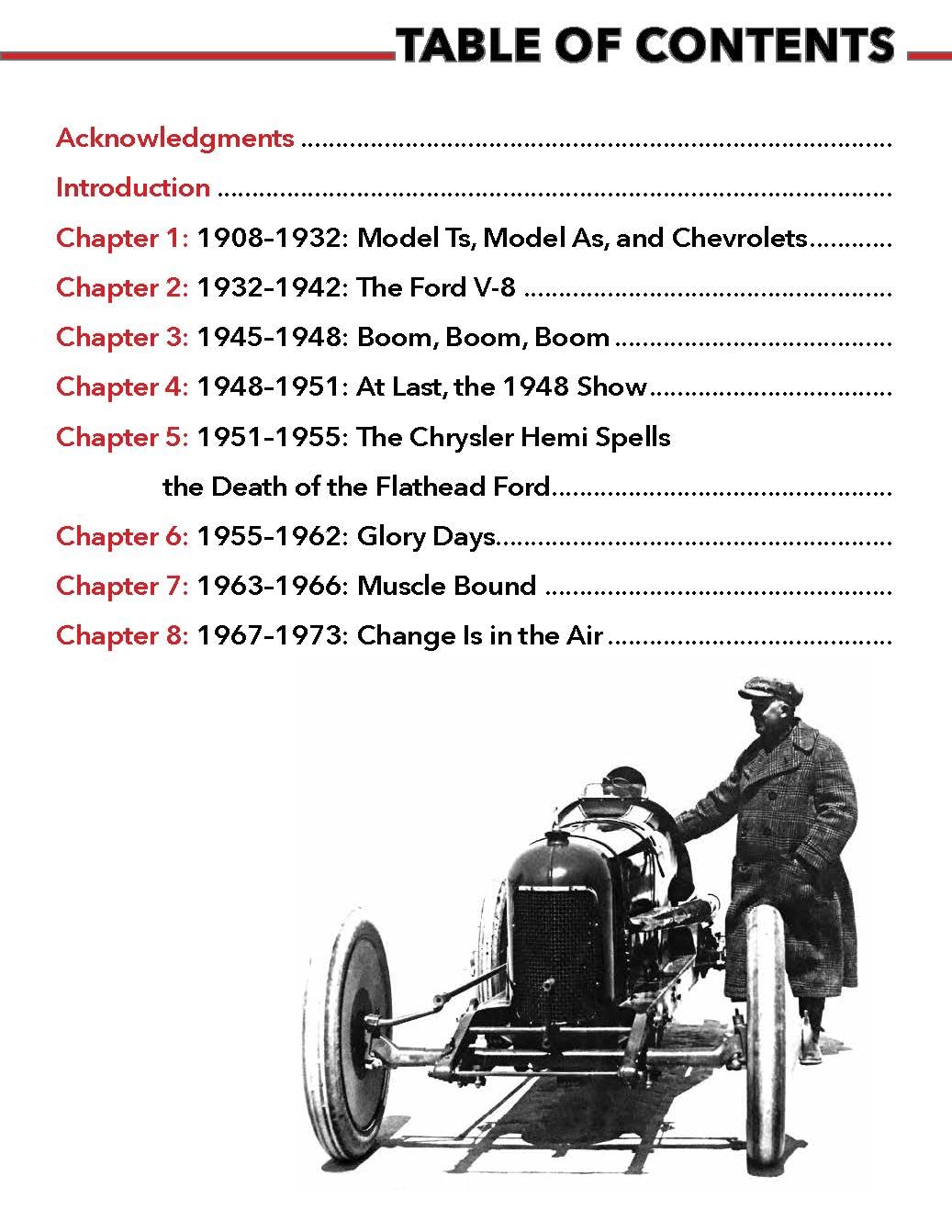
1908-1932: Model Ts, Model As and Chevrolets
A cutaway of a Model A block fitted with a Miller-Schofield rocker arm head was photographed at Speedway’s Museum of American Speed. Fitted with a pair of Winfield Model S carburetors, it could produce more than 80 hp. (Photo Courtesy Scotty Gosson)

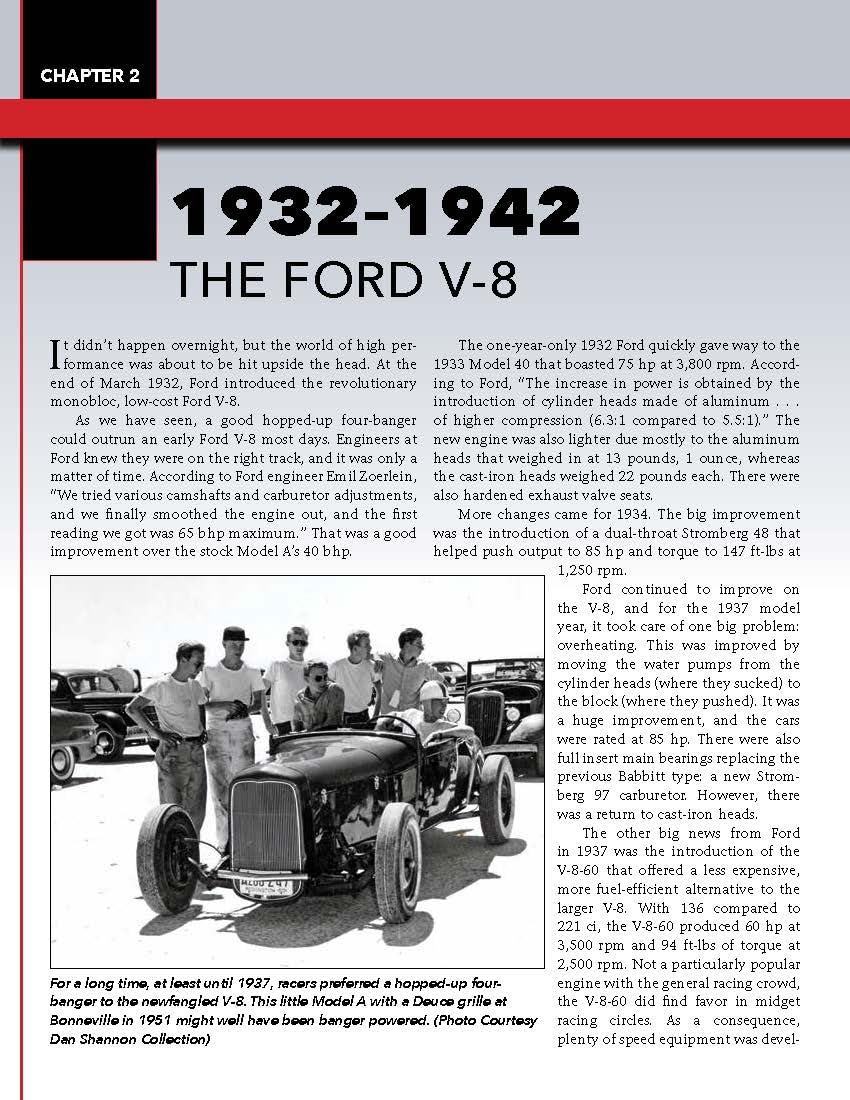
1932-1942: The Ford V-8
Rare solid copper Federal Mogul heads had no water passages and relied upon Thermo Flow cooling. Bob McGee’s roadster was originally fitted with a Bertrand cam, a Burns intake, and a pair of Strombergs.

1945-1948: Boom, Boom, Boom
The Ardun OHV conversion for flathead Fords is the stuff of legends. But when it was introduced by Zora Arkus-Duntov in 1947, it was too little and too late, and Ford was not interested. (Photo Courtesy HandHFlatheads.com)
1948-1951: At Last, the 1948 Show

More than a few people turned up, and the Hot Rod Show was a huge success. Even Ford had an exhibit proclaiming that 656 of 678 cars competing in the SCTA Speed Trails are powered by Ford or Mercury engines.

The Death of the Flathead
Introduced for the 1951 model year, Chrysler’s Fire Power Hemi kissed the flathead Ford V-8 goodbye. It is a tight fit in a Model 40, but with four Stromberg 97s atop a Weiand intake, it’s just enough.

The Glory Days
For a while, swapping fuel-injected Corvette engines into anything and everything was popular, but for many, getting them running and maintaining optimum performance was difficult. (Photo Courtesy Dan Shannon)

Muscle Bound
Early-era BB Chevys often had Weber-fed induction, aluminum M/T valve covers with tall breathers, and white-painted headers. A few years later, everything had changed. Polished aluminum gave away to chrome valve covers, a tall Weiand tunnel-ram intake, a pair of Holleys with chrome float covers, and that yellow Accel ignition.

Publisher : CarTech
Publication date : October 10, 2022
Language : English
Print length : 192 pages
ISBN-10 : 1613256973
ISBN-13 : 978-1613256978
Item Weight : 2.31 pounds
Dimensions : 8.5 x 0.5 x 11 inches
Best Sellers Rank: #335,788 in Books (See Top 100 in Books) #127 in Automotive Racing #162 in Automotive History (Books)
Customer Reviews: 4.5 4.5 out of 5 stars 15 ratings var dpAcrHasRegisteredArcLinkClickAction; P.when(‘A’, ‘ready’).execute(function(A) { if (dpAcrHasRegisteredArcLinkClickAction !== true) { dpAcrHasRegisteredArcLinkClickAction = true; A.declarative( ‘acrLink-click-metrics’, ‘click’, { “allowLinkDefault”: true }, function (event) { if (window.ue) { ue.count(“acrLinkClickCount”, (ue.count(“acrLinkClickCount”) || 0) + 1); } } ); } }); P.when(‘A’, ‘cf’).execute(function(A) { A.declarative(‘acrStarsLink-click-metrics’, ‘click’, { “allowLinkDefault” : true }, function(event){ if(window.ue) { ue.count(“acrStarsLinkWithPopoverClickCount”, (ue.count(“acrStarsLinkWithPopoverClickCount”) || 0) + 1); } }); });